
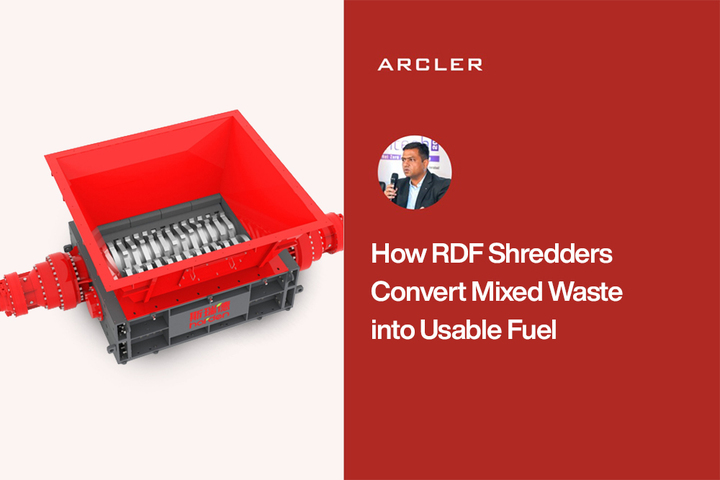
How RDF Shredders Convert Mixed Waste into Usable Fuel
As industries move toward cleaner and more sustainable energy sources, Refuse Derived Fuel (RDF) has emerged as a reliable alternative to fossil fuels especially in cement kilns, power plants, and industrial boilers. At the heart of RDF production lies one critical machine: the RDF shredder.
An RDF shredder plays a vital role in converting mixed municipal and industrial waste into uniform, processable material that can be used as fuel. With growing adoption of waste-to-energy and co-processing technologies, the demand for consistent RDF quality has never been higher.
What Is an RDF Shredder?
An RDF shredder is designed to reduce heterogeneous waste streams into controlled particle sizes suitable for further separation or direct fuel use. Depending on the project configuration, RDF shredders may operate as:
- Primary shredders for coarse size reduction
- Secondary or fine shredders for refined, kiln-ready fuel
In practical RDF processing plants, shredding is the first and most decisive step, as it directly impacts fuel quality, downstream efficiency, and combustion stability.
Typical RDF Shredding Size Requirements
Different industries and combustion systems require different RDF sizes. The shredder configuration is selected accordingly.
| Shredding Stage | Typical Output Size | Application |
| Primary Shredding | 150–300 mm | Initial size reduction, sorting & separation |
| Intermediate Shredding | 80–150 mm | Air classification, metal removal |
| Fine / SRF Shredding | <50 mm or <30 mm | Cement kiln injection, advanced fuel feeding |
Smaller and more uniform particle sizes improve drying efficiency, feeding control, and calorific consistency.
Why the RDF Shredder Is the Foundation of Fuel Preparation
A well-designed RDF shredder determines whether mixed waste can be transformed into a stable and usable fuel. Poor shredding leads to inconsistent RDF, equipment blockages, and unstable combustion.
Key Functions of an RDF Shredder
1. Waste Homogenization
RDF shredders handle diverse waste materials such as:
- Municipal solid waste (MSW)
- Packaging waste
- Plastics and films
- Textiles, wood, and light industrial waste
By breaking these into uniform particles, the shredder creates a homogeneous fuel stream.
2. Particle Size Control for Efficient Separation
Consistent particle sizing improves the performance of:
- Air density separators
- Magnetic and non-ferrous metal separators
- Screens and classifiers
This leads to cleaner RDF with lower inert content.
3. Improved Combustion Performance
Smaller, uniform particles increase surface area, allowing:
- Faster drying
- Stable feeding
- Predictable heat release in kilns and boilers
RDF to SRF: When Fine Shredding Becomes Essential
In some applications, RDF is further upgraded into Solid Recovered Fuel (SRF) , a higher-grade fuel that meets strict industrial standards.
Why Secondary (Fine) Shredding Matters
- Produces 30–50 mm or <30 mm fuel for kiln injection
- Improves bulk density and pneumatic conveying
- Reduces moisture and calorific variability
- Supports compliance with international SRF quality standards
- Enhances combustion stability in cement and WtE plants
Fine shredding is especially important for cement manufacturers seeking consistent thermal substitution rates.
Choosing the Right RDF Shredder Technology
Different shredder designs are used depending on waste composition and output requirements.
| Shredder Type | Best Use Case |
| Dual-Shaft Shredder | Mixed MSW, bulky waste, high contamination |
| Four-Shaft Shredder | Controlled sizing, sensitive downstream separation |
| Single-Shaft Fine Shredder | SRF production, precise particle control |
High-torque, low-speed shredders are preferred for RDF due to their ability to handle contaminants with minimal downtime.
Performance & Economic Benefits of Quality RDF Shredding
Investing in the right RDF shredding system delivers measurable operational and financial advantages.
Key Benefits
- Lower operating costs through reduced wear and maintenance
- Higher fuel value due to consistent calorific output
- Improved plant reliability across conveyors, separators, and feeders
- Stable combustion critical for cement kilns and high-temperature systems
- Scalability for future capacity expansion
Uniform RDF also improves long-term offtake agreements with cement plants and industrial users.
Arcler’s Approach to RDF Shredding Solutions
At Arcler Projects, RDF shredding systems are designed as part of an integrated fuel preparation line, not as standalone machines.
Our approach includes:
- Waste stream analysis before equipment selection
- Customized shredder configurations for MSW, industrial waste, and AFR
- Integration with screening, metal removal, and air separation systems
- Energy-efficient layouts for reduced operational costs
- End-to-end EPC support from design to commissioning
By aligning shredding technology with real-world waste conditions, Arcler ensures consistent, kiln-ready RDF that meets industrial fuel standards.
Conclusion
An RDF shredder is more than a size-reduction machine—it is the backbone of alternative fuel production. From waste homogenization to combustion stability, shredding quality defines the success of any RDF or SRF project.
With the right shredder configuration and system integration, mixed waste can be transformed into a reliable, energy-rich fuel, supporting sustainability goals and reducing dependence on fossil fuels.
Looking to build or upgrade an RDF processing plant? Arcler can help you design the right shredding solution.


