
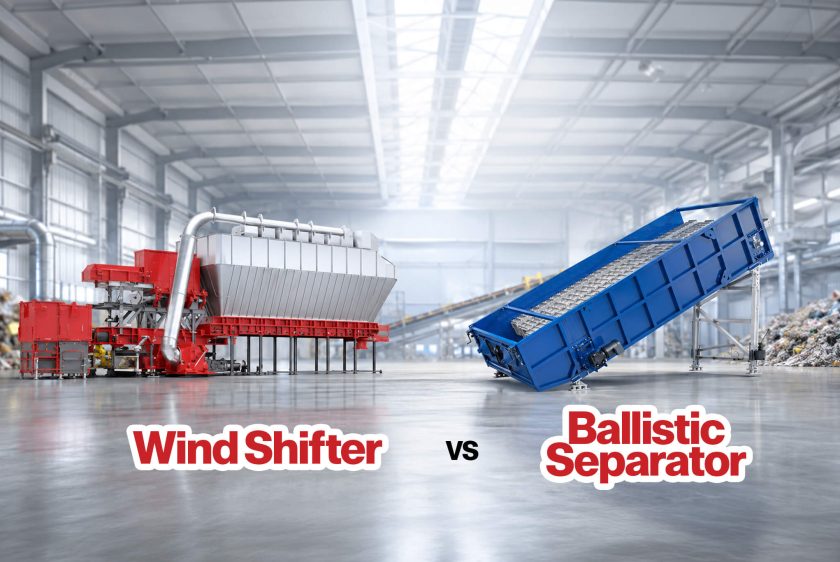
Ballistic Separator vs Wind Shifter: Which Waste Separation Technology Is Right for Your Plant?
As waste management systems evolve, the need for efficient waste separation has become more important than ever. Whether it’s producing high-quality Refuse Derived Fuel (RDF), improving recycling rates, or reducing landfill waste, selecting the right separation technology directly impacts the performance and profitability of a waste processing plant.
Two of the most widely used technologies are the Ballistic Separator and the Wind Shifter (Air Density Separator). While both are designed to separate waste streams and improve material recovery, they work on different principles and are suited for different applications.
In this blog, we’ll compare both technologies, explore their strengths, and help you determine which solution best fits your waste processing requirements.
Why Efficient Waste Separation Matters
Modern waste processing plants handle highly mixed waste streams containing plastics, paper, textiles, metals, glass, stones, soil, and organic matter. Without effective separation, valuable recyclable materials are lost, RDF quality decreases, and operational costs increase.
Advanced separation technologies help achieve:
- Higher recycling efficiency
- Improved RDF quality for cement plants
- Reduced contamination
- Lower landfill disposal
- Better performance of downstream equipment
- Increased resource recovery and sustainability
Choosing the right separation equipment is the first step toward building an efficient and future-ready waste processing plant.
What is a Ballistic Separator?
A Ballistic Separator is a mechanical waste sorting machine that separates mixed waste based on shape, size, and density using oscillating paddles and inclined screening decks.
Unlike conventional screening systems, it creates three distinct output streams simultaneously:
- 2D Materials: Plastic films, paper, cardboard, textiles
- 3D Materials: Plastic bottles, cans, rigid containers, stones
- Fine Fraction: Sand, soil, glass fragments, dust, and other small particles
The machine uses ballistic motion to move flat materials upward while heavier rolling materials move downward. Fine particles pass through perforated screens during the process.
Because of its high separation accuracy, the Ballistic Separator is widely used in:
- Municipal Solid Waste (MSW)
- Material Recovery Facilities (MRF)
- Plastic Recycling Plants
- Packaging Waste
- Construction & Demolition Waste
- RDF and SRF Processing
What is a Wind Shifter (Air Density Separator)?
A Wind Shifter, also known as an Air Density Separator, separates waste materials using a controlled stream of air instead of mechanical motion.
When mixed waste enters the separation chamber, lightweight materials are lifted and carried forward by airflow, while heavier materials fall due to gravity.
Typically, the machine separates:
Light Fraction
- Plastic film
- Paper
- Textiles
- Foams
- Combustible materials
Heavy Fraction
- Stones
- Glass
- Metals
- Sand
- Construction debris
Because it removes unwanted heavy inert materials before further processing, the Wind Shifter is an essential component in:
- RDF Processing Plants
- Legacy Waste Processing
- Municipal Solid Waste Plants
- Construction Waste Recycling
- Industrial Waste Recycling
Ballistic Separator vs Wind Shifter: A Detailed Comparison
| Feature | Ballistic Separator | Wind Shifter (Air Density Separator) |
| Separation Principle | Mechanical oscillating paddles | Controlled airflow |
| Separation Basis | Shape, size & density | Density & weight |
| Output Streams | 2D, 3D & Fine Fraction | Light & Heavy Fraction |
| Best Applications | MRF, plastic recycling, packaging waste | RDF plants, legacy waste, industrial waste |
| Handles Fine Dust | Moderate | Excellent |
| Stone Removal | Good | Excellent |
| Plastic Film Separation | Excellent | Excellent |
| Moisture Handling | Good | Best for relatively dry waste |
| Integration | MRF, optical sorting lines | RDF & waste-to-energy systems |
| End Goal | Material recovery & recycling | Cleaner combustible fraction |
Which Technology Should You Choose?
There is no one-size-fits-all answer. The ideal choice depends on your waste composition and the final objective of your plant.
Choose a Ballistic Separator if:
- Your primary goal is recycling.
- You process municipal solid waste.
- You need to separate 2D and 3D materials.
- Your facility includes optical sorters.
- You operate a Material Recovery Facility (MRF).
Choose a Wind Shifter if:
- Your goal is producing high-quality RDF.
- You process legacy waste.
- Your waste contains high levels of stones and inert material.
- You require efficient density separation.
- You operate Waste-to-Energy or cement co-processing facilities.
Can Ballistic Separators and Wind Shifters Work Together?
Absolutely.
In fact, many modern waste processing plants achieve the best results by integrating both technologies into a single processing line.
A typical workflow may look like this:
Waste Feeding → Screening → Ballistic Separator → Wind Shifter → Magnetic Separator → Optical Sorter → Shredder → RDF Production
In this configuration:
- The Ballistic Separator first classifies waste into 2D, 3D, and fine fractions.
- The Wind Shifter then removes remaining heavy inert materials from the combustible stream.
- Optical sorters recover valuable recyclables.
- Shredders prepare the combustible fraction into consistent RDF suitable for cement kilns and waste-to-energy plants.
This integrated approach improves separation efficiency, enhances RDF quality, and maximizes overall resource recovery.
Why Integrated Separation Systems Deliver Better Results
Instead of relying on a single machine, combining multiple separation technologies offers several advantages:
- Higher recovery of recyclable materials
- Better removal of stones, dust, and inert fractions
- Cleaner combustible material for RDF production
- Reduced wear on downstream shredders
- Lower operational and maintenance costs
- Improved plant efficiency and profitability
For municipalities and industries managing mixed waste streams, an integrated system provides a more sustainable and cost-effective solution.
Arcler’s Complete Waste Separation Solutions
At Arcler, we design and deliver integrated waste processing systems tailored to the specific needs of each project. Rather than supplying standalone equipment, we develop complete solutions that maximize recovery, improve operational efficiency, and support circular economy goals.
Our solutions include:
- Ballistic Separators
- Wind Shifters (Air Density Separators)
- Disc Screens & Vibrating Screens
- Optical Sorters
- Magnetic Separators
- Single & Dual Shaft Shredders
- RDF & AFR Processing Plants
- Material Recovery Facilities (MRF)
- Legacy Waste Processing Plants
Every system is engineered to integrate seamlessly with existing operations while delivering consistent, high-quality output.
Conclusion
Both Ballistic Separators and Wind Shifters play a critical role in modern waste processing, but they solve different challenges.
If your focus is advanced recycling and material recovery, a Ballistic Separator offers excellent sorting based on shape and size. If your priority is producing cleaner RDF by removing heavy contaminants, a Wind Shifter is the ideal choice.
For many facilities, the most effective solution is not choosing one over the other—but integrating both into a well-designed waste processing line.
At Arcler, we help municipalities, recyclers, and industrial waste processors build customized systems that combine advanced separation technologies with intelligent plant design to maximize recovery, improve RDF quality, and support sustainable waste management.


